Use a release checklist tied to the approval evidence
Define the object, owner and expected state before changing any setting.
Build a controlled SOP release workflow from approved candidate through protected master, controlled copy, acknowledgement and reconciliation.
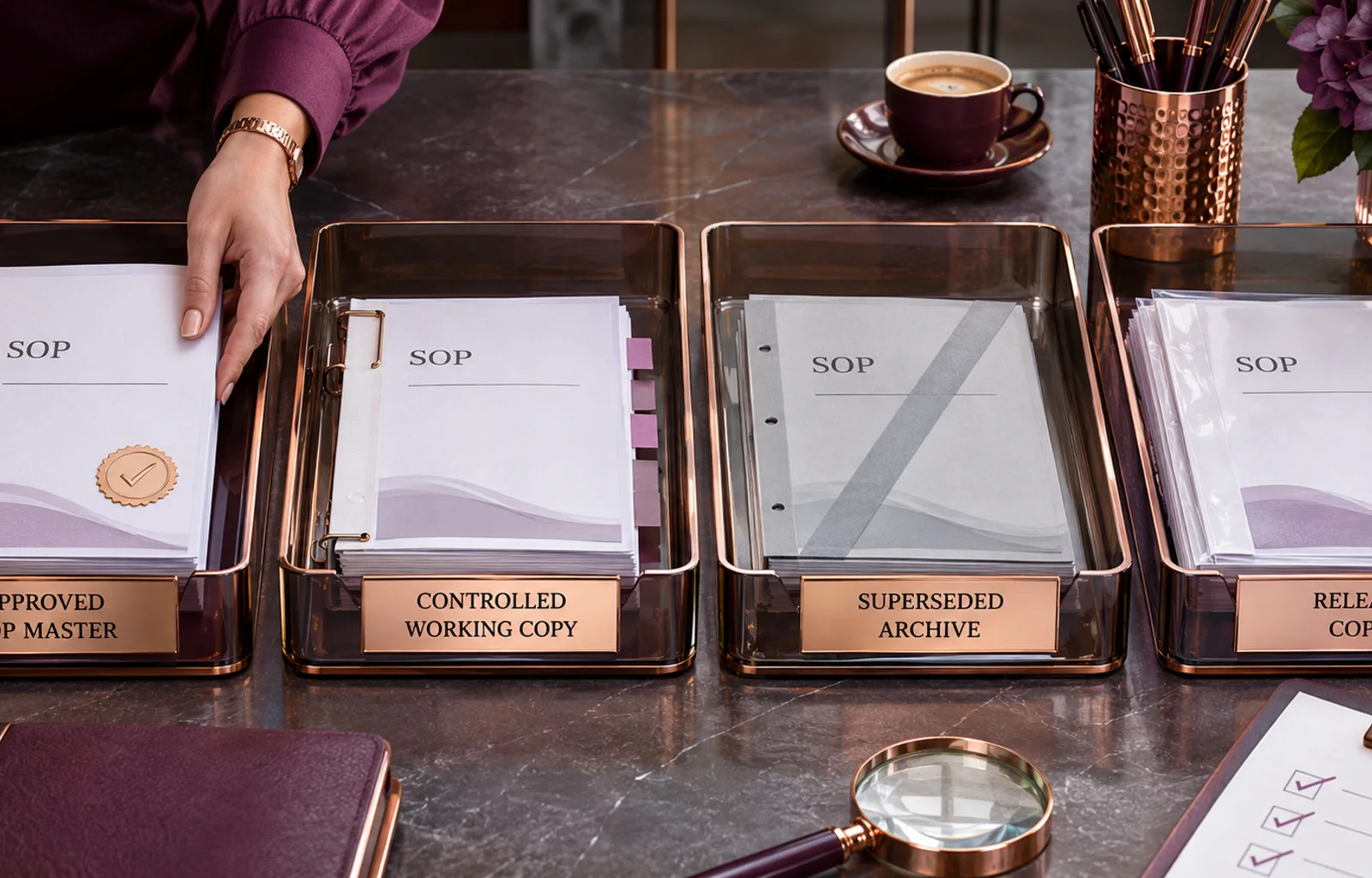
Release an SOP through a named sequence: verify approval, freeze the master, create the distribution copy, record recipients, and reconcile superseded editions.
Even a protected master can fail operationally if the wrong revision is distributed, a recipient keeps an obsolete copy, or the release record does not match the file. Distribution is a workflow, not a download button.
Make the release gate observable. The releaser should be able to show which approval was checked, which file was frozen, which copy was issued, who received it and what happened to the prior edition.
Build the release packet while the work is happening. Capture the approval reference, candidate comparison, master path, revision identity, effective date, distribution destinations and superseded-copy action before the release is announced. A packet created later from memory is less reliable and may miss an attachment, printed copy or local workstation that still exposes the prior procedure.
Test the workflow with a fictional revision change from start to finish. Include a normal release, a recipient who is unavailable, a controlled paper copy and an exception that must be escalated. Measure whether staff can identify the current SOP without asking the document author. If the route depends on personal knowledge, the process is not yet resilient.
Use this guidance as a review framework rather than a universal configuration. Record the exact Windows version, storage location, account type, document application and protection-tool release used in each test. Repeat representative checks after migrations, updates or ownership changes. A control is ready only when staff can operate it, evidence it and recover from failure without weakening the approved-document boundary.
Each layer addresses a different failure path. None should be treated as proof of the others.
Define the object, owner and expected state before changing any setting.
Test the ordinary workflow with fictional material and record the observed result.
Separate technical restriction from approval, backup and human authorization.
Assign an exception owner and a date for review or closure.
Repeat the test when storage, account, software or process conditions change.
Use fictional material for destructive tests and preserve the live approved master.
Receive the approved candidate and approval record
Verify identifier, revision and effective date
Compare the candidate with the expected baseline
Move it into the protected master boundary
Generate a controlled release copy
Distribute through the approved channel
Reconcile recipients and older editions
Close the release with evidence and exceptions
A release packet can include the SOP identifier, revision, source approval, master comparison, release date, distribution destinations, acknowledgement state, superseded-revision action and unresolved exception. Keep it concise enough to operate consistently.
Protection does not guarantee that a recipient reads, follows or destroys a procedure. It also cannot retract an unmanaged attachment. Training, acknowledgement, distribution governance and process observation remain necessary.
Prefer a controlled release copy so recipient access does not require exposure to the master path.
Define an expedited but documented path with an owner, temporary status, review deadline and later reconciliation.
Number or identify controlled paper copies where required and include them in withdrawal and reconciliation.
Select only conditions verified on the actual workflow. The result is a decision aid, not a system scan.